
Franklin County Sex Offender Checks
The central public source for a Franklin County sex offender lookup is the Virginia Sex Offender and Crimes Against Minors Registry. The Virginia Department of State Police Criminal Justice Information Services Division maintains that database. It is the right first stop for a name search, a county-wide view, or a check near a street address. The Franklin County Sheriff's Office is the local point of contact for registration questions and reports of suspected noncompliance, but no separate county list or local public map was verified.
Choose a search path that fits the question. A name works best when the spelling and an added identifier are known. County, city, ZIP, street, and radius tools serve neighborhood awareness. Review the full profile before drawing a match from a result card. Names repeat, photos age, and address status can change. The registry provides notification data, while the Franklin County Court Case Lookup is the better route for the later pleadings and disposition in a specific prosecution.
Franklin County Registry Map Redesign
VSP reported that the redesigned public registry launched on October 31, 2023. The change matters in Franklin County because the search is no longer limited to a surname list. It supports geographic routes such as county, city, ZIP, street address, radius, and map views. VSP also reported filters for incarcerated, homeless, and civilly committed statuses. Those options help a reader distinguish a mapped residential result from a record whose current status does not fit a standard home address.
The portal's exact live radius choices, result limits, and button labels were not verified in the research capture. Use the choices displayed by VSP at search time. Do not assume that an old screenshot lists every current option. A status filter also should not be read as a finding about guilt or risk. It describes how the registry classifies the listed person's present public status.
VSP's official forms index shows the state registry and criminal-history forms context.
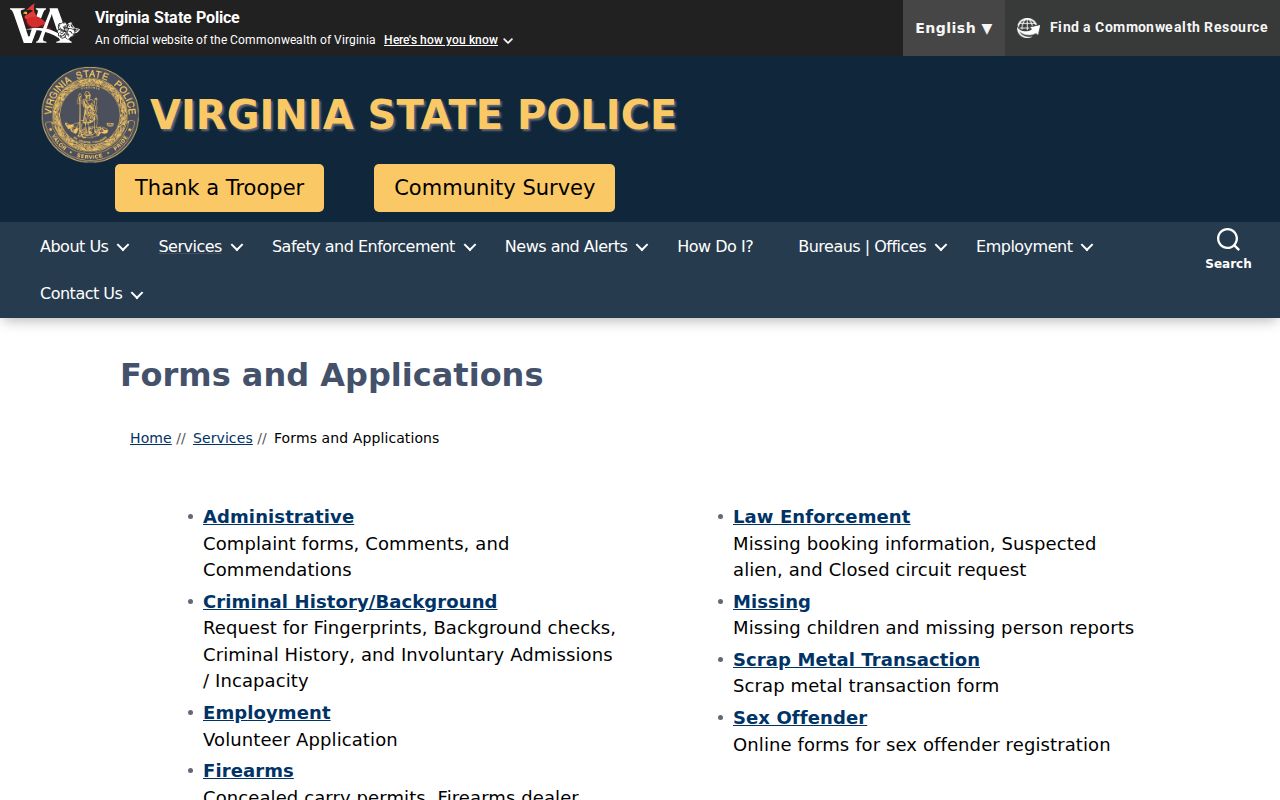
The state forms page reinforces that public searching, formal notice, and agency administration are related but distinct registry functions.
Virginia Sex Offender and Crimes Against Minors Registry Searches
Start at the official VSP portal and use the narrowest reliable facts. A county filter can establish the Franklin County pool, while an address and radius can focus on a specific area. A SOR number is more precise than a name when it is known. The search controls documented by VSP give several paths, and no single field was established as mandatory for all search modes.
- Open the Virginia registry and read its conditions of use before continuing.
- Select a name, SOR number, county, city, ZIP, street address, or radius route that fits the facts you have.
- For a place search, choose Franklin County and apply only relevant status filters. Review both map and list views when offered.
- Open a possible match and compare aliases, physical details, address, offense, tier, status, and the last verification or update.
The search form may change, so the table distinguishes verified functions from labels that need a live check.
| Field Label | Type | Required | Notes |
|---|---|---|---|
| Last Name / First Name | Text | Depends on route | Use both when known and confirm identity in the profile. |
| SOR Number | Identifier | No | A precise alternate route when the state number is known. |
| County | Dropdown | No | Select Franklin for a county-focused result set. |
| City / ZIP Code | Geographic fields | No | Useful for Rocky Mount, Boones Mill, or a ZIP-focused check. |
| Street Address / Radius | Address and dropdown | No | Supports proximity searching; confirm the current radius choices live. |
| Status Filters | Filters | No | VSP reports incarcerated, homeless, and civilly committed choices. |
Franklin County Offender Registration Contact
The Franklin County Sheriff's Office is the practical local contact for a person who must register, someone who needs to ask about local verification, or a resident who sees a possible compliance issue. Contact the sheriff at 70 East Court Street, Rocky Mount, Virginia 24151, or call 540-483-3000 and ask for registry staff. The office has not published separate registry counter hours, appointment rules, or a registration fee, so confirm those points through the official sheriff website before traveling.
VSP remains the central registry manager. Its registry unit can be reached at 804-674-2825 or sor@vsp.virginia.gov. That division of work is important. The sheriff handles local registration contact and ground-level reports, while VSP maintains the public statewide database. A resident who thinks a Franklin County profile is stale should save the SOR number and the field in question, then contact the sheriff or VSP instead of posting the person's details elsewhere. A request for a releasable sheriff-created record uses the office's Franklin County record-request form.
For an immediate threat, call 911. A suspected late update or registration failure without an immediate emergency belongs with the sheriff or VSP.
Registry Profiles: What They Show
A Virginia public profile combines identity, qualifying offense, location, and compliance fields. It is a statutory notice record, not a complete Franklin County court file or a current supervision report. The offense and conviction entries explain why registration applies. Address, vehicle, and verification fields aid public notice. They do not reveal the full set of pleadings, confidential supervision notes, or every other case tied to that person.
| Name & Aliases | Published names and alternate names used to help distinguish records. |
|---|---|
| Photo & Physical Description | Photos plus permitted details such as sex, race, age or birth information, height, weight, eyes, hair, and identifying marks. |
| Registered Address | Residential address, locality, and ZIP, or a public status that explains why a standard home address is not shown. |
| Offense & Statute | The qualifying offense, law, conviction date, and jurisdiction reported for registration. |
| Tier & Other Details | The Virginia tier plus employment, school, and vehicle fields when the statute permits public display. |
| Registration Status | Last verification or update data and any wanted or noncompliant flag shown by VSP. |
Match several fields and check the update date. A similar name alone is too weak to identify a person.
Franklin County Registry and NSOPW
The Virginia portal is the primary source for Franklin County registry details. The U.S. Department of Justice's National Sex Offender Public Website, or NSOPW, adds a cross-state layer. It is useful when a search spans a state line, when a former location is outside Virginia, or when the person's present state is not known. NSOPW queries participating jurisdictions; it does not replace the state agency that owns and updates a Virginia profile.
The national site provides a useful visual reference for that wider search path.
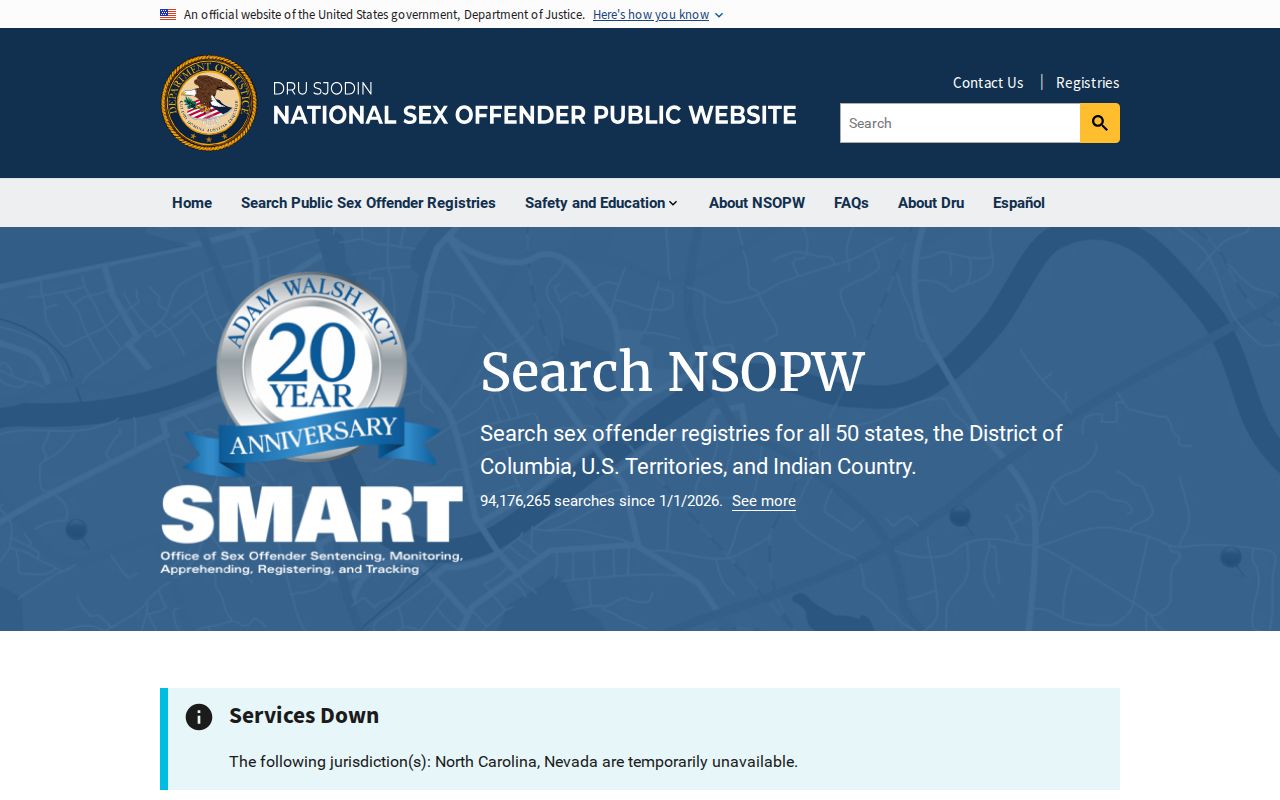
Use an NSOPW match to find the source jurisdiction, then open that jurisdiction's official profile for its current fields and contact route.
Searching both systems can answer different questions. VSP offers Virginia-specific tier, status, and local fields. NSOPW helps locate public listings across jurisdictions. A mismatch should be referred to the agency that maintains the underlying profile, not treated as proof that either search is false.
Registration Levels and Duties in Virginia
Virginia tier rules require care. Section 9.1-908 imposes an ongoing registration duty unless a court removes a person who is eligible. Sections 9.1-908 and 9.1-910 do not create automatic 15-year or 25-year expiration dates. Those figures are the earliest petition windows for qualifying people with one Tier I or one Tier II offense. A court order and the rest of the statute still control removal.
| Level / Category | Duration or Earliest Petition Point | Public Effect |
|---|---|---|
| Tier I | Duty continues unless removed; one-offense petition may begin after at least 15 years from the later statutory starting event. | Profile remains public while registration duty continues. |
| Tier II | Duty continues unless removed; one-offense petition no earlier than 25 years under § 9.1-910. | Profile remains public while registration duty continues. |
| Tier III | Lifetime under § 9.1-908; no ordinary removal. | Lifetime public registration applies. |
| Murder or former § 18.2-67.2:1 | Lifetime. | Lifetime public registration applies. |
| Two or more registrable offenses | Excluded from ordinary removal under § 9.1-910. | Do not apply the single-offense petition windows. |
The public profile may show tier and last verification information, but no county-specific verification schedule was published in the research. Ask Franklin County registry staff about the duty that applies to a specific registration record.
Franklin County Sex Offender Residence Myths
Virginia does not support one simple statewide claim that every registered person must live a fixed distance from every school, park, or child-care site. Restrictions can turn on the offense, a person's status, supervision conditions, the type of place, and the governing law. A radius on the VSP map is a public search tool. It is not proof of a legal residence buffer.
For a Franklin County concern, first read the profile without inferring an unstated condition. Questions about a listed address or registration duty belong with the Franklin County Sheriff or VSP. Questions about a case-specific court order belong in the court file, and supervision conditions may not appear on the public registry at all. This split prevents a map circle from being mistaken for a legal boundary.
Note: A mapped result shows proximity chosen by the user, not a ruling that the listed address violates Virginia law.
Franklin County Registry Notification Channels
Public portal tools and formal institutional notice are not the same service. VSP Form SP-285 supports notice to eligible organizations in the same or a contiguous ZIP area, while Va. Code § 9.1-914 governs registry notifications. Eligibility and the form's terms control that route. It should not be described as a general county mailing list for every resident.
For everyday Franklin County awareness, use the public registry's live search and any electronic alert option VSP currently presents. For a broader regional check, use NSOPW. If a profile seems out of date, record the SOR number, the visible field, and the date observed. Send those facts to Franklin County registry staff or VSP. Do not confront a listed person or circulate copied profile data as a substitute for an agency report.
Using Registry Information Lawfully
Registry information supports personal, family, and community safety. It may help a resident understand public notices, plan a route, or check an area through official geographic tools. It does not authorize a person to trespass, threaten, intimidate, harass, or take enforcement action. The sheriff and VSP investigate suspected noncompliance. Courts decide guilt and impose legal consequences.
Virginia Code § 18.2-472.1 penalizes a registrant's failure to register, false registration information, and related violations. That law does not turn members of the public into compliance officers. The registry form also warns that unlawful intimidation or harassment based on its information is prohibited and punishable as a Class 1 misdemeanor.
Use the registry for safety: The Virginia Registry Act governs this public system, and the VSP warning states that unlawful intimidation or harassment based on registry information is punishable as a Class 1 misdemeanor. Report suspected noncompliance to the Franklin County Sheriff or VSP and reserve 911 for an immediate emergency.